

APDA/AFPPD Webinar: Impact of Social Media on Children and Young People
10 November 2025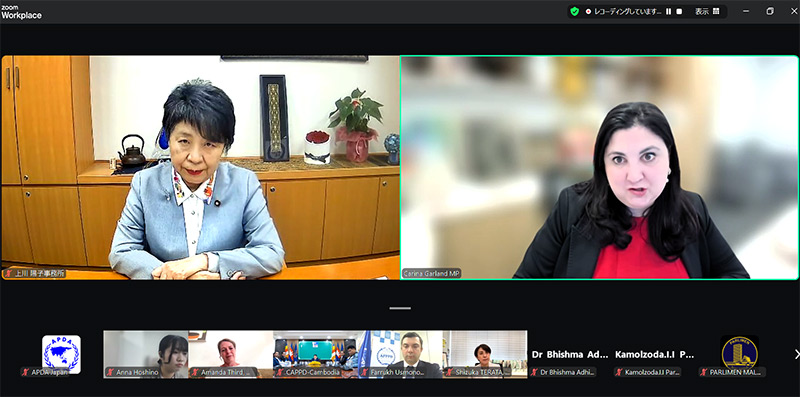
On 10 November, the webinar titled “Impact of Social Media on Children and Young People” was organized by the Asian Forum of Parliamentarians on Population and Development (AFPPD) and Asian Population and Development Association (APDA).
Approximately 60 participants, including parliamentarians, experts, government officials, and representatives of civil society from 17 countries joined the webinar. The event provided a valuable opportunity to share insights on Australia’s pioneering initiatives, as well as the current situation surrounding the ban on social media in Nepal.
In the opening remarks, Hon. Kamikawa Yoko, Chair of AFPPD and Chair of the Japan Parliamentarians Federation for Population (JPFP), raised key concerns noting that while social media connects young people worldwide and offers important opportunities for learning and self-expression, it also entails risks such as psychological impacts, exposure to harmful contents, and negative effects on daily life. She emphasized the importance of evidence-based policies to ensure a safe digital environment for children and young people.
In Session 1, Hon. Dr. Carina Garland, MP and Co-Chair of APGPD, explained Australia’s “Online Safety Amendment (Social Media Minimum Age) Act 2024”, which sets a minimum age of 16 for the creation and holding of social media accounts, noting that the measure aims to protect children’s healthy development while ensuring appropriate digital literacy. Professor Amanda Third, Co-Director of the Young and Resilient Research Centre at Western Sydney University, highlighted risks such as young people migrating to more dangerous online spaces, differing parental perspectives, and the ease with which children can access harmful content even without registered accounts. She underscored the importance of feature-based regulations, ecosystem approaches involving parents, industry, and government, as well as strengthened international cooperation.
In Session 2, Professor Bipin Adhikari of Kathmandu University, Nepal, examined recent Gen Z-led protests. He explained that the government’s ban on 26 social media platforms, combined with growing frustration over corruption, economic inequality, and demands for digital freedom, triggered nationwide demonstrations. Platforms such as Instagram and TikTok played a central role in information-sharing and mobilization, ultimately contributing to the reversal of the ban, the collapse of the government, and the call for fresh elections. He also noted that Nepal’s current legal framework remains insufficient, highlighting the need to strike a balance between privacy protection, democratic freedoms, appropriate regulation, and international cooperation.
In closing, Hon. Kamikawa reiterated the importance of continued parliamentary follow-up after the implementation of Australia’s legislation, active information-sharing among participants, and reflecting young people’s voices in policymaking. The webinar was held with the support of the International Planned Parenthood Federation (IPPF) and Plan International Japan, in collaboration with the Australian Parliamentary Friends on Population and Development (APGPD) and National Forum of Parliamentarians on Population and Development of Nepal (NFPPD).