

APDA/JPFP JPFP Project Team Meeting on “Life Safety Education” Held
14 April 2026, Tokyo, Japan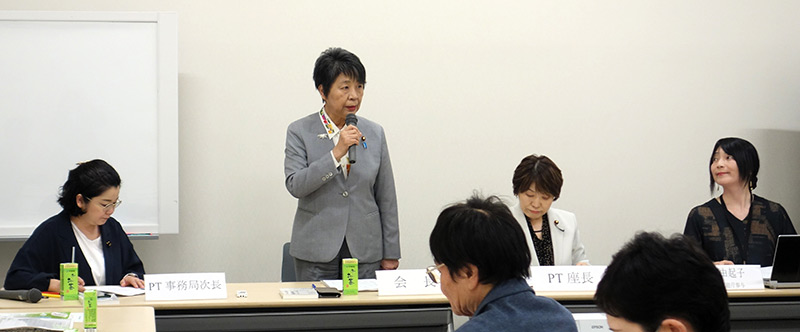
On 14 April, the Japan Parliamentarians Federation for Population (JPFP) held a meeting of the Project Team on “Life Safety Education (LSE)”. The meeting was moderated by Hon. Otsuji Tomomi, Deputy Secretary-General of the JPFP Project Team on LSE. At the outset, Hon. Kamikawa Yoko, Chair of JPFP, delivered opening remarks. She noted that the implementation of LSE varies across prefectures and schools, and emphasized the importance of learning from good practices on the ground and scaling them up more widely. This was followed by a presentation from Hon. Dr. Abe Toshiko, Chair of the JPFP Project Team on LSE, on the “Life Safety Education Digital Teaching Material Idea Contest”. The contest intends to invite young people to design mechanisms and pathways that encourage their peers to proactively access official learning materials on LSE.
Ms. Tsuji Yukiko (Adviser to the Children and Families Agency) delivered a lecture based on her own experience and her perspective as a certified social worker. She introduced the programme of “Life Education” at Tajima Minami Elementary and Junior High School in Osaka City. The programme was developed in the context of child poverty measures and aims to enhance children’s self-esteem through accurate knowledge and dialogue, while fostering their ability to protect themselves and live proactively. The curriculum is structured according to developmental stages: lower grades learn about topics such as “private zones” and “children’s rights”, middle grades focus on “the ability to seek help” and “coping with emotional trauma”, and junior high students study issues such as “dating violence” and “child abuse”, enabling them to learn about real-life challenges from multiple perspectives. The programme has reported zero cases requiring medical treatment due to interpersonal violence over six years, as well as improvements in academic performance. Ms. Tsuji emphasized that these issues are not individual problems, but rather social challenges rooted in structural factors such as a lack of knowledge and support systems and fragmentation of institutions. She stressed the importance of structured education from an early age to prevent such problems from arising.
Ms. Miki Nagashima of Plan International Japan presented proposals from the civil society. In light of the current situation in which LSE does not yet reach all children sufficiently, she highlighted three key points: (1) ensuring implementation in all schools, (2) designing programmes that can be integrated into existing curricula, and (3) strengthening implementation systems through the use of external experts. In the discussion, participants raised practical issues such as improving teachers’ expertise and strengthening teaching systems. It was also confirmed that further discussions will continue on how to better embed respect for human rights in education and how to strengthen coordination between policy and practice.